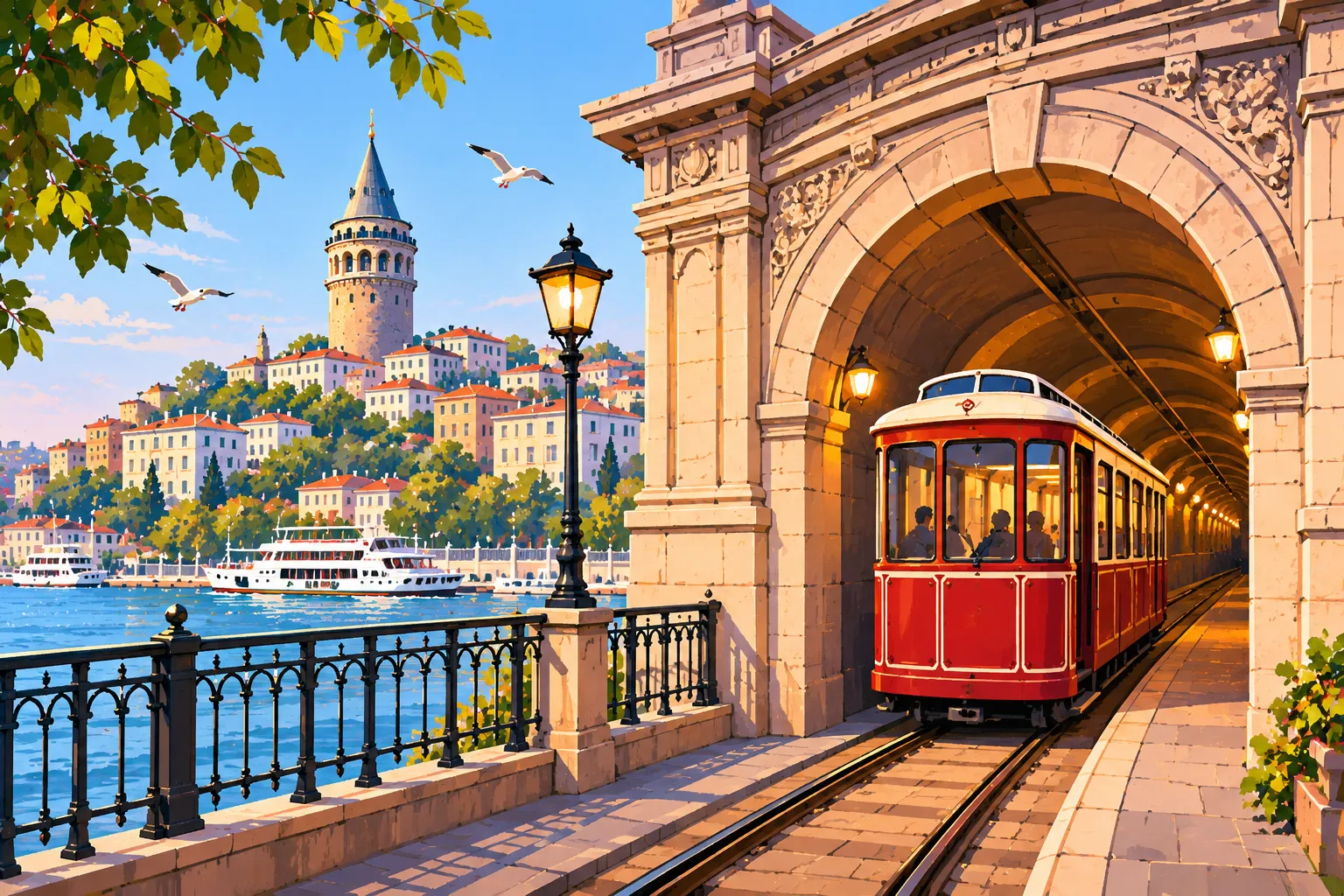
In the heart of Istanbul, a historic line running between Karaköy and Beyoğlu has held a special place in the city’s memory for nearly 150 years. The Beyoğlu–Karaköy Tunnel, also known as the Galata Tunnel or the Historic Tunnel, opened on 17 January 1875 and is considered one of the world’s oldest underground railway systems—a remarkable feat of engineering.
This historic line is just 573 meters long, linking the lively streets of Karaköy with the cultural spirit of Beyoğlu. Today, known as the F2 Karaköy–Beyoğlu Historic Tunnel line, it stands as a milestone in Istanbul’s public transport story.
So what’s the story of the Galata–Beyoğlu Tunnel? Who built the Karaköy Tunnel? Is the world’s second-oldest metro really in Istanbul? Where does the Karaköy Tunnel depart from, how many minutes does it take, and what are the operating hours? Here’s everything you want to know about Istanbul’s underground heritage.
What Is the Beyoğlu–Karaköy Tunnel?
The Beyoğlu–Karaköy Tunnel is a historic underground funicular on Istanbul’s European side, providing transport between Karaköy and Beyoğlu’s Tünel Square. Locals also call it the Galata Tunnel, the Karaköy Tunnel, or simply the Historic Tunnel.
Built during the Ottoman Empire, the system was developed to overcome the steep slopes between Galata and Pera. Unlike today’s modern metro lines, it shuttles passengers over a short distance between two stations.
The most important thing about the Historic Tunnel is that it’s more than mere transport. It’s a living symbol of Istanbul’s modernization, engineering heritage, and urban mobility culture.
Key Features of the Karaköy–Beyoğlu Tunnel
- Opening date: 17 January 1875
- Founder: French engineer Eugène-Henri Gavand
- Length: Approximately 573 meters
- Number of stations: 2
- Route: Karaköy – Beyoğlu
- Line code: F2
- System: Underground funicular
- Operator: IETT
- Journey time: Approximately 90 seconds
What’s the Story of the Galata–Beyoğlu Tunnel?
The story of the Galata–Beyoğlu Tunnel is rooted in the rapidly changing commercial and social life of 19th-century Istanbul. At the time, Galata was a major hub of banks, trading houses, and port activity. Pera, as Beyoğlu was then known, stood out for its embassies, hotels, entertainment venues, and European lifestyle.
One of the biggest barriers to travel between these two centers was the steep slope now known as Yüksek Kaldırım. People had to walk between Karaköy and Beyoğlu every day. For traders, workers, and porters, the route was especially demanding.
French Engineer Henri Gavand’s Discovery in Istanbul
When French engineer Eugène-Henri Gavand arrived in Istanbul in 1867, he observed the heavy foot traffic between Galata and Pera. Realizing that the steep incline hindered movement, he designed a railway system to connect the two areas underground.
Gavand presented his project to the Ottoman authorities and received a construction concession from Sultan Abdülaziz on 6 November 1869. It was the first official step in a project that would transform Istanbul’s transport history.
How Did Construction of the Historic Tunnel Begin?
Following financing and preparatory work, construction of the Tunnel started on 30 July 1871. Considering the technology of the time, building an underground transport system in a densely built area was a major engineering achievement.
Engineers worked on ground conditions, gradient, ventilation, and the safety of the rail system. After a build period of just over three years, the 573-meter line was completed in December 1874.
17 January 1875: A Historic Day in Istanbul
When the Galata Tunnel opened on 17 January 1875, it ushered in a new era of urban mobility in Istanbul. The grueling climb between Karaköy and Beyoğlu could now be covered with a short underground ride.
In its early years, the system ran on steam power—an unusual sight for the people of the time. Underground carriages sparked both curiosity and concern. IETT’s historical records note that animals were transported in the cars to demonstrate the system’s safety.
As the Tunnel became part of daily life, it did more than ease travel; it also helped strengthen the economic and social ties between Galata and Beyoğlu.
Is the Karaköy Tunnel the World’s Second-Oldest Metro?
Yes, the historic Karaköy–Beyoğlu Tunnel is widely presented as the world’s second-oldest underground urban railway after the London Underground. Technically, though, it’s classified today as a funicular line.
The first section of the London Underground opened in 1863. Istanbul’s Historic Tunnel began carrying passengers in 1875.
For this reason, the Tunnel is one of Istanbul’s key landmarks in global transport history. That said, classic metro, underground rail, and funicular systems fall into different technical categories.
Even if it’s not structured like today’s Istanbul metro lines, the Historic Tunnel remains one of the most valuable pieces of the city’s rail transport heritage.
Which Tunnel Was Found Beneath Istanbul?
One of the city’s historic underground transport structures is the Galata Tunnel, which links Karaköy and Beyoğlu. It’s not a recently discovered secret passage, but a planned 19th-century construction that opened in 1875 as a public transport line.
Istanbul also has underground sites such as the Basilica Cistern, the Theodosius Cistern, historic water channels, and various archaeological structures from different eras. Unlike those, the Historic Tunnel was designed specifically for moving people.
Visitors interested in Istanbul’s underground past can pair a Galata Tunnel ride with cistern visits in the Historic Peninsula to explore engineering works from different periods.
Who Built the Taksim Tunnel?
In Istanbul, transport systems referred to as the “Taksim Tunnel” are sometimes confused with one another. The Historic Karaköy–Beyoğlu Tunnel was designed by French engineer Eugène-Henri Gavand.
Gavand’s system was realized during the reign of Sultan Abdülaziz and opened in 1875.
However, the F1 Kabataş–Taksim Funicular running between Taksim Square and Kabataş is a different system. This modern line opened in 2006.
The Difference Between the Historic Tunnel and the Taksim Funicular
F2 Karaköy–Beyoğlu Historic Tunnel: Operates between Karaköy and Beyoğlu Tünel Square. Opened in 1875.
F1 Kabataş–Taksim Funicular: Connects Kabataş and Taksim Square. A modern system opened in 2006.
T2 Taksim–Tünel Nostalgic Tram: A separate surface tram line on Istiklal Street between Taksim Square and Tünel Square.
These three systems have different routes, so it’s helpful to check line codes when planning travel in Istanbul.
What Are the Stations of the Karaköy–Beyoğlu Tunnel?
The Karaköy–Beyoğlu Historic Tunnel has just two stations. With no intermediate stops, passengers travel directly from the origin to the other end.
1. Karaköy Station
The Karaköy Tunnel entrance is close to Karaköy Square. It’s an easy walk from the Karaköy tram stop and the Galata Bridge area.
Karaköy Station is very convenient for visitors heading to the Galata Tower and the lower end of Istiklal Street.
2. Beyoğlu Tünel Station
The Beyoğlu station sits at the Tünel Square end of Istiklal Street. From here you can walk to the Galata Tower, the Şişhane area, and Istiklal Street.
To reach Taksim Square, you can walk along Istiklal Street or, when operating, take the T2 nostalgic tram.
How Many Minutes Does the Karaköy–Beyoğlu Tunnel Take?
The ride from Karaköy to Beyoğlu on the Historic Tunnel takes about 90 seconds. It’s a huge help if you’d rather avoid climbing the steep Yüksek Kaldırım slope.
The short journey time makes the Historic Tunnel handy for both daily commuters and visitors exploring Istanbul.
The distance is walkable, but thanks to the Tunnel you can skip a strenuous uphill climb.
Operating Hours of the Karaköy–Beyoğlu Tunnel
According to IETT’s published regular schedule, the operating hours of the F2 Karaköy–Beyoğlu Historic Tunnel are:
- Monday–Saturday: 07.00 – 22.45
- Sunday: 07.30 – 22.45
Intervals may vary depending on passenger demand and operating conditions. Services may be temporarily suspended due to public holidays, maintenance, or special security decisions.
For up-to-date Karaköy Tunnel hours and announcements, check IETT’s official Historic Tunnel page.
Is the Karaköy Tunnel Operating?
Under normal circumstances, the Karaköy–Beyoğlu Historic Tunnel operates as a public transport line. However, services may be temporarily halted due to periodic maintenance, official decisions, or special events.
In particular, certain events and security arrangements around Taksim, Istiklal Street, and Beyoğlu may affect F2 operations.
Therefore, to find out whether the Karaköy Tunnel is operating today, it’s best to check IETT’s latest announcements before your trip.
Where Is the Karaköy Tunnel Entrance?
The Karaköy Tunnel entrance is in Istanbul’s Beyoğlu district, around Karaköy Square and Tersane Avenue. Walking from the Galata Bridge towards Karaköy, you can easily reach the historic station.
From other parts of Istanbul, you can reach Karaköy via the T1 Kabataş–Bağcılar tram line, ferries, and nearby public transport connections.
The entrance on the Beyoğlu side is in Tünel Square, at the southwestern end of Istiklal Street.
How Does the Galata Tunnel Work?
The Historic Tunnel operates on the funicular principle—a cable-hauled rail system on a slope. Two cars shuttle passengers between the stations in a counterbalanced arrangement.
Originally powered by steam, the system was converted to electric operation in 1971, updating the historic line with modern technology.
In 2007, vehicles and various system components were upgraded. While preserving its historic character, the line was adapted for contemporary passenger service.
Today, the Historic Tunnel offers a striking transport experience that brings Istanbul’s past and present together.
The Galata Tunnel’s Importance in Istanbul’s History
The Galata Tunnel’s significance isn’t just that it’s among the world’s oldest underground transport systems. It also represents Istanbul’s economic, social, and architectural transformation in the 19th century.
In the late Ottoman period, Istanbul was a major hub for international trade and diplomacy. There was a strong link between commercial life in Galata and social life in Pera.
The Historic Tunnel eased daily movement between these two areas, adding a new dimension to the city’s transport infrastructure.
Today, modern metros, trams, and funiculars connect different parts of Istanbul, while the Galata Tunnel continues to stand as an early example of urban rail in the city.
Places to See Around the Galata Tunnel
You can make the Historic Tunnel ride part of your Istanbul itinerary. The areas around Karaköy and Beyoğlu are full of historic buildings, art venues, and vibrant street life.
Galata Tower
A short walk from Tünel Square brings you to the Galata Tower—one of Istanbul’s icons—famous for its historic architecture and panoramic city views.
Istiklal Street
Step out of the Beyoğlu Tünel station onto Istiklal Street. With its historic arcades, shops, galleries, and cultural venues, it’s one of Istanbul’s liveliest avenues.
Galata Mevlevihanesi
The Galata Mevlevihanesi is one of the city’s important historic sites reflecting Istanbul’s cultural and Sufi heritage. Its location near Tünel Square makes it easy to include in the same outing.
The Streets of Karaköy
Karaköy stands out with its historic hans, cafés, art spaces, and architecture. Step out of the Historic Tunnel’s Karaköy station to explore the neighborhood streets.
Galata Bridge
Stretching between Karaköy and Eminönü, the Galata Bridge is a great spot to take in views of the Golden Horn and watch Istanbul’s daily life.
A Short Route from Karaköy to Beyoğlu via the Historic Tunnel
If you’re planning a half-day in Istanbul, you can build a short walking route around the Historic Tunnel.
- Arrive at Karaköy Square and explore the historic surroundings.
- Ride the F2 Karaköy–Beyoğlu Tunnel up to Beyoğlu.
- Stroll around Tünel Square and the Galata Mevlevihanesi.
- Walk towards the Galata Tower.
- Spend time in Galata’s historic streets.
- Walk along Istiklal Street to soak up Beyoğlu’s cultural atmosphere.
This route is ideal if you want to experience Istanbul’s historic transport heritage and see Beyoğlu’s highlights in a single day.
Frequently Asked Questions about the Beyoğlu–Karaköy Tunnel
What’s the story of the Galata–Beyoğlu Tunnel?
The Galata–Beyoğlu Tunnel was designed by French engineer Eugène-Henri Gavand to make travel easier on the steep slope between Karaköy and Beyoğlu. Construction began in 1871 and it opened on 17 January 1875.
Which tunnel was found beneath Istanbul?
One of Istanbul’s historic underground transport structures is the Karaköy–Beyoğlu Tunnel. It’s not a recent discovery—it’s a historic line that opened in 1875.
Who built the Taksim tunnel?
The Historic Karaköy–Beyoğlu Tunnel was designed by French engineer Eugène-Henri Gavand. The modern F1 funicular operating between Taksim and Kabataş is a different system.
Is the Karaköy Tunnel operating?
While the Karaköy–Beyoğlu Historic Tunnel has a regular operating schedule, services may be suspended due to maintenance or official decisions. IETT has an announcement of a service suspension effective from 28 June 2026. Always verify the current operating status with IETT before you travel.
In what year was the Karaköy–Beyoğlu Tunnel built?
Construction of the Historic Tunnel began on 30 July 1871, was completed in December 1874, and the line opened on 17 January 1875.
The Karaköy Tunnel is the world’s how-manyth oldest metro?
The Karaköy–Beyoğlu Tunnel is widely presented as the world’s second-oldest underground urban railway after the London Underground. Technically, it’s a historic funicular line.
What are the stations on the Karaköy–Beyoğlu Tunnel?
The F2 Karaköy–Beyoğlu Historic Tunnel has two stations: Karaköy and Beyoğlu. There are no intermediate stops.
How long does the Karaköy–Beyoğlu Tunnel take?
The historic funicular ride between Karaköy and Beyoğlu takes about 90 seconds. The line length is approximately 573 meters.
What are the Karaköy Tunnel hours?
According to IETT’s regular schedule, the Historic Tunnel operates Monday to Saturday 07.00–22.45 and on Sundays 07.30–22.45. Due to temporary suspensions, always check the current operating status with IETT before you travel.
Where is the Karaköy Tunnel entrance?
The Karaköy Tunnel entrance is around Karaköy Square and Tersane Avenue. On the Beyoğlu side, the station is at the Tünel Square end of Istiklal Street.
Is the Galata Tunnel the same as the Taksim Tunnel?
No. The F2 Karaköy–Beyoğlu Historic Tunnel runs between Karaköy and Beyoğlu. The F1 Kabataş–Taksim Funicular connects Kabataş and Taksim Square.
Why was the Galata Tunnel built?
The Galata Tunnel was built in the 19th century to ease travel between commercial Galata and the social and commercial life of Pera, and to overcome the steep Yüksek Kaldırım slope.
Sources and Further Information
- IETT – Historic Tunnel and Timetables
- Istanbul Governor’s Office – A Journey Through History: The Tunnel
- IETT 2025 Activity Report – Historic Tunnel
Note: Operating hours, fares, and conditions may change. Check official updates before your visit.